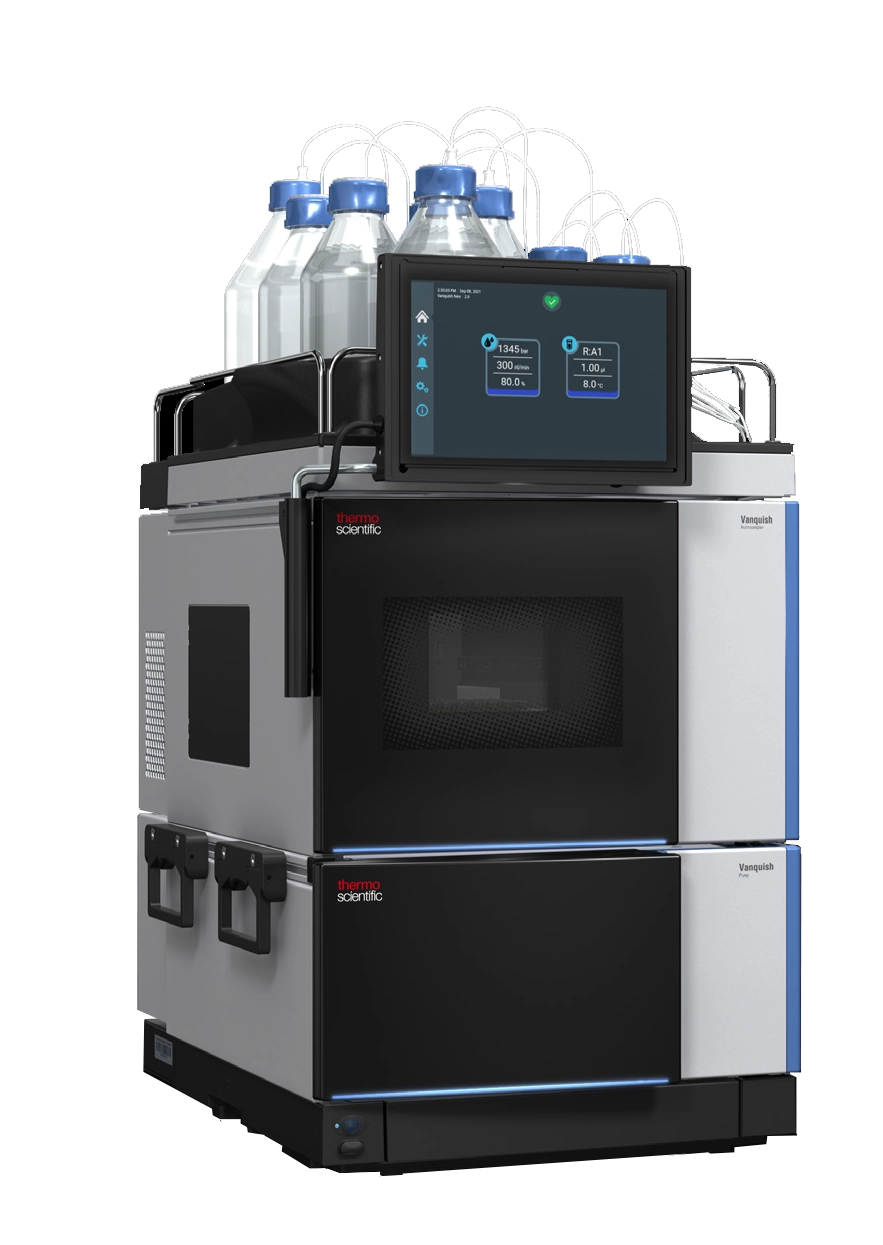
Vanquish Neo UHPLC system sets new performance standards for single-shot nanoLCMS bottom-up proteomics
Bottom-up proteomics research seeks to both identify and quantify the complete proteome within a cell, tissue, or organism. As the depth of proteome profiling increases, so does our insight into complex physiological processes and their effects on phenotype, potentially leading to advancements in fields including biomarker discovery and precision medicine. The enormous variety and dynamic range of proteins found in biofluids such as human plasma or cells necessitates tools for high sensitivity, high specificity, and robust measurements. In deep proteome profiling, nanoLC based methods using long columns and shallow gradients coupled to high-resolution mass spectrometers are used to characterize and identify as many peptides and proteins as possible. The past 20 years have seen significant innovation in LC-MS instrumentation for the separation and detection of peptides in digests, as well as in the power of the analysis tools required to analyze the increasingly complex data sets.
One key metric for quantifying performance in gradient chromatography is peak capacity, or the theoretical maximum number of fully resolvable peaks within a separation. At higher peak capacities more peptides are chromatographically resolved, leading to increased sensitivity for low level peptides and, ultimately, more identifications. For reversed-phase liquid chromatography, peak capacity is proportional to the square root of the column length. Improving peak capacity requires either smaller particles or longer columns, both of which place increased pressure demands on nanoLC instruments. Longer (shallower) gradients have also been shown to improve peptide peak capacity in reversed-phase separations. Classical proteomics workflows employ 75 μm I.D. columns packed with 2 μm particles operated at flow rates from 200 to 500 nL/min. Under such conditions, the use of columns longer than 50 cm severely limits sample throughput, in some cases to just a handful of samples/day.Concomitant washing and equilibration steps coupled with system dead volume further limit sample throughput and MS utilization.

While downscaling column diameter can lead to improved method sensitivity, the main contributor to increased sensitivity at nano- and capillary-flow rates is the inverse relationship between flow rate and electrospray ionization (ESI) efficiency.Additionally, lower flow rates afford enhanced sampling of analytes by the mass spectrometer and reduced ionization suppression by matrix components. As such, efforts to reduce analysis overhead time should focus on increasing the speed of sample loading and column equilibration while maintaining low-flow rates during the sample separation and MS data acquisition step. Similarly, efforts to keep the gradient delay volume to a minimum, by employing low volume nanoLC system designs together with optimized fluidic configurations are crucial considerations for maximizing analysis throughput and MS utilization in nanoLCMS analysis.
Another critical attribute in proteomics workflows is column-to-column reproducibility. Although high peak capacities enable deep proteome profiling, without reproducible separations across multiple columns it can be difficult to draw reliable conclusions.
Here we demonstrate the latest advances in nanoLCMS using the Vanquish Neo UHPLC system coupled with an Orbitrap Exploris 480 mass spectrometer for deep proteome profiling in HeLa cell protein digests. The Vanquish Neo extended pressure capabilities yield highly reproducible separations from 75 μm I.D. × 50 cm and 75 μm I.D. × 75 cm PepMap Neo columns for improved peak capacities and opens the door to the possibility of running even longer separation columns to achieve unsurpassed separation performance. Fast, sample loading and equilibration made possible via the 1500 bar pressure rating on both UHPLC system and consumables, deliver improved method throughput and increased MS utilization. Furthermore, advanced needle washing procedures minimize system carryover without wasting valuable MS duty cycle time. With a 4-hour gradient method, the identification of 80,000 peptides and over 7000 proteins in a single-shot nanoLCMS experiment with data-dependent acquisition (DDA) mode and more than 80% MS utilization for a direct sample injection workflow is achieved.
More info, click the link below:
There are no reviews yet.